Industry Scuttlebutt – EMO, Moneyball, Tax Breaks, and Oil Prices

In talking to my correspondent who attended last week’s EMO show in Hanover, Germany, the mood in Europe is profoundly bullish. The aisles were packed and the frauleins in the booths were smiling. Every day the financial casino trembles with each whisper from Athens and Bonn, but at EMO people were quoting and selling stuff – lots of stuff.

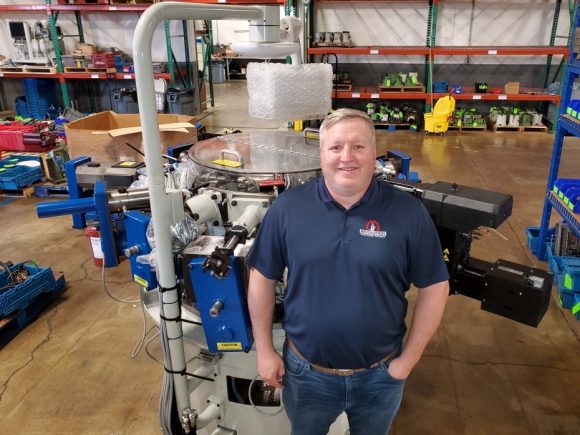
Bill Cox of Cox Manufacturing in San Antonio was really excited by the new Tornos multi, which is basically six sliding headstock machines in one unit. It’s called the Tornos 514 and has a built-in integrated short barloader. Very elegant design with no Hirth Coupling or Geneva mechanism.

They have sold a few beta units in Europe and expect to be delivering in America early next year. Bill thought it could be a “game changer.”

***************

In the oil trading pits at the Nymex Exchange, crude oil in the U.S. is trading for around $80 per barrel, but Brent crude is around $30 a barrel higher. The pump price we pay seems tied to the European price, which is supposedly affected by the curtailment of shipments from Libya. To me this smacks of collusion on consumer pump prices with producers pocketing a windfall here.

***************

Very little is being written about the potential expiration of the liberal write-offs for capital equipment. For folks in the machining world this is a very big deal. If there is no extension – and with the standoff in Congress it looks like President Obama’s jobs infrastructure proposal is Dead On Arrival – the tax goodies will end December 31. If business holds up I foresee a rush to buy equipment in the fourth quarter.

***************

I saw “Moneyball,” the movie. Terrific performance by Brad Pitt as Oakland A’s General Manager Billy Beane, the former #1 draft pick who never really made it in the Major Leagues. The narrative nicely weaves Beane’s personal story and his search for a more effective way to evaluate what makes successful players and teams. As a baseball junkie I would have preferred more emphasis on the use of statistical metrics in the choice of players rather than the focus on the emotional and charismatic Beane, but with Brad Pitt as Executive Producer of the flick and the desire to make another blockbuster like “The Blindside” I can understand the choices. The movie is good and worth seeing – it just wasn’t the movie of the book I loved so much.

***************

For those who are interested, I’ve lost 15 pounds in six weeks. No bread, very few sweets. I’m a little worried about Thanksgiving.

Question: Who do you this will win this year’s World Series?

 Brad Pitt promoting his new film “Moneyball”

Treasure Hunting

A picture of the SS Gairsoppa taken only one day ago by Odyssey Marine Exploration on their expedition.

A picture of the SS Gairsoppa taken only one day ago by Odyssey Marine Exploration on their expedition.

I’m in the business of finding gold in companies aged machine discards. To label our business as treasure hunting romanticizes the grimy work of sending flaked paint and replacing pitted bearings.

I read a fascinating article in the September 24th New York Times about a more traditional treasure hunting expedition worthy of my hero, Indiana Jones. A team of shipwreck treasure hunters has signed a deal with the British government to extract up to 240 tons of silver from the sunken SS Gairsoppa, which was torpedoed by a German U-boat 300 miles southwest of Ireland in 1941.

The boat had left Calcutta laden with tea, iron and tons of silver in December 1940. It joined a military convoy in Sierra Leon with 83 seamen on board and two gunners headed for Liverpool. Terrible weather conditions forced the ship to separate from the convoy and head for Galway.

The U-boat commander found the floundering ship and sunk it with one torpedo in the North Atlantic. Only one man survived after spending 13 days in a lifeboat.

Today the cargo is in play because robot technology has enabled salvagers to locate the sunken ship, three miles under the surface. Odyssey Marine Exploration of Tampa, Florida, is confident they have found the wreck and have signed a deal with the British government to attempt to lift the silver. Under the deal Odyssey assumes all of the risk in the expedition for 80 percent of the proceeds. The British government gets 20 percent of the take.

This is going to require some pretty nimble robots, robust lights and cameras, and some husky claws to pull out the submerged cargo. Think of the water pressure three miles deep. And they still may strike out because the surveillance robots have found the tea chests but not the precious metals vault.

I love the story. Even if they don’t pull up the sunken silver it will make a great series for Mike Rowe on the Discovery Channel or grist for a Steven Spielberg epic.

Silver bullion, three miles deep, the British Navy, Nazi U-boats. Add some beautiful women and George Clooney to the crew and you have the ingredients of a blockbuster. I wonder if the tea survived intact.

Question: Is Greed Good?

An Ignorant View of a Factory Worker

Seth Godin, one of my favorite bloggers, wrote a piece this month called “Back to (the Wrong) School,” in which he argued that the U.S. education system is designed to churn out conformist, obedient factory workers. He claims the system is an an anachronism based on 1920s industrial revolution thinking. He says schools need to be emphasizing initiative, creativity, and risk taking because countries with cheap labor are going to beat us at the commodity producing race. Godin is right that our schools need to encourage more critical thinking and less standardized testing, but sadly he like so many people in the U.S. doesn’t understand that modern machinists require exactly the qualities that he is preaching schools need to teach.

I talked about the blog with my friend Miles Free, Director of Technology and Industry Research for the PMPA and also a fan of Seth Godin. He summarized Godin’s naivety nicely. Miles wrote this back to me on Facebook, “A worker bee wants to do a repetitive task–actually those are better done by automated equipment. Or, they want to be told what to do and not be ‘responsible.’ In our shops, we need responsible people who are self-starters and able to understand what they are trying to do, not just obey orders. Seth correctly points out there is no value in either of those behaviors. But a skilled machinist gets handed a piece of paper with lines and numbers on it and sets up a machine, and creates tooling and then produces parts by the score. That’s value! That’s responsibility. That’s risk.”

Question: Do you feel that U.S. schools are inferior to those of other countries?

Read Seth Godin’s blog here.

Early 20th century factory in Germany

A Leadless Machining World: Interview with Miles Free

By Lloyd Graff

Miles Free - Directory of Industry Research and Technology for the Precision Machined Products Association

Miles Free - Directory of Industry Research and Technology for the Precision Machined Products Association

LG: I am with Miles Free of the PMPA, and we are talking about the unleaded world of materials. Is lead to steel as trans fat is to food?
MF: It seems to be; although I don’t know what benefit trans fat gives to food. We can certainly document the energy savings that lead gives to steel for machining, let alone brass and aluminum. The state religion seems to be “lead is bad.”

Where did this come from?
It comes from the European Union’s belief in the precautionary principle on lead. It’s kind of disturbing. The EU says when an activity raises threat to human health or the environment, precautionary measures should be taken even if some of the cause and effect relationships are not fully established scientifically. To me this is really a state of faith that any suspicion of any threat to the environment really trumps the lack of scientific evidence that the threat really exists. They’ve turned the burden of proof upside down and said, “Prove absolutely that your product is harmless.”

It sounds like global warming.
Very much so.

So what is the underlying scientific hunch about  lead?
I don’t know in terms of what its proposed mechanism for environmental or personal harm is in machined parts. Lead was a real problem from tail pipe emissions, but that lead was reduced 96 percent with unleaded gas. Lead got its face on a reward poster that it’s a bad actor. I don’t know how many children in Europe are expected to ingest screw machine parts. I don’t know how many cars have to end up in an acid bog to raise the net level of lead. I don’t get it.

Read full article here

Know When to Hold ‘em, Know When to Fold ‘em

Herb Cohen

I’ve been negotiating deals for a living for a long time. It’s my livelihood, but I often feel like a bumbling novice.

Noah and I drove up to Western Michigan this week to facilitate a three cornered transaction—never easy.

While driving we listened to a CD by Herb Cohen, author of the superbly useful and entertaining book, You Can Negotiate Anything, which I recommend to everyone. My wife Risa and I have also attended Cohen’s lectures and Noah interviewed him in Today’s Machining World.

The thrust of his message was that successful bargaining relies on attaining information about the real needs of the other party, and then providing many options for him or her to choose from because you don’t really know the keys to an eventual agreement until you explore several possibilities. Cohen also emphasized that negotiations usually take time and successful ones usually require both sides putting in a significant time investment.

These are concepts I’ve learned and tested—and forgotten. I think most people develop a negotiating style which is “one size fits all.” Unfortunately people come in small to XXXL. You can’t negotiate with a Brazilian the same way you do with a guy from L.A. Clients from South America prefer a long slow tango. In California it’s “let’s get this done.”

The most memorable lesson from listening to Herb Cohen and tossing it around with Noah was that you need to “get out of yourself” to negotiate successfully. You can’t care too much about a particular outcome or you become extremely vulnerable to a shrewd bargainer. This is why people sometimes hire others to negotiate for them. The person who can negotiate without anxiety has a huge advantage over the one who feels like he’s playing with his last chips. If you are negotiating for yourself or your family or your company or organization you need to be able to get comfortable with you own discomfort. How do you do this?

No easy answer except practice, role-playing, coaching, and learning from experience. I like to do a post mortem on negotiations to analyze where I’ve succeeded or left money on the table, or worse, allowed a doable deal to collapse.

Kenny Rogers’ wonderful song, The Gambler, with the famous lyrics “Know When to Hold em, Know When to Fold ‘em,” rings in my head. Today I’ll add this corollary. Know when to go back to school again on the techniques of negotiation that will work for you every day.

Question: What is your best or worst gambling experience?


Interview with Photographer Greg Davis

Photographer Greg Davis in Paupa, New Guinea

In 2004, Greg Davis quit his desk job and sold his belongings to travel the world for 14 months. He used a $400 point-and-shoot Olympus camera to document his journey. After showing his photos to his girlfriend upon returning home, he realized he had a natural talent for photography. Many of Davis’s images have been recognized by the art community nationwide, and he has just signed a contract with National Geographic’s Image Collections.

Are your photos usually taken spontaneously, or do you spend a while setting up your shots?
GD:
Ninety-nine percent of my work is a brief moment in a time. There’s the shot, and there it goes. I can’t ask the person to redo a situation that I saw but missed. The moment’s there. I’m either present or I don’t capture that image. I miss a lot of shots, and that’s okay. I wasn’t [supposed] to get that shot.

Are most of your photos portraits?
GD
: I do like the portrait. There’s something about the people that I have captured. They captured me first. Whatever was in their spirit, their soul, their eyes, the way that they looked at me, the way they presented themselves to me, the way that they were open to me, allowed me to capture what it is that you see.

I read on your Web site about a woman in Vietnam who had a profound impact on you. Can you tell me about her?
GD
: Nine months into my one-year trip my life was literally reborn the moment I crossed paths with the “The Blanket Weaver,” which is what I call the image of her. It’s an image of two hands—one green, one blue, colored by the dye from her work. I captured the image in the mountains of Vietnam on a remote trail outside of a village called Sapa. I took one photograph, smiled and walked on my way. I had no idea that that particular moment was going to define these last five years of my life.

Read full article here

Diary of a Used Machinery Dealer

6:00 AM – Wake up and pick up the iPad next to my bed to check email from Europe and Asia. Nothing interesting except some Tornos cam machines in Lithuania.

6:30 – Turn on CNBC to check out the world markets. Talking heads are bemoaning Greece on the verge of default and the awful economy. Joe Kernin and Rick Santelli are hopelessly pessimistic and angry at Obama. Why am I watching this crap? Turn on Sports Center.

7:00 – Hit the treadmill. I turn CNBC on the TV and watch while on the treadmill. Listen to more dumb economists and self-serving politicians. Am I on the treadmill or are the TV idiots? Yes, we both are.

8:00 – Risa is slowly waking up to NPR. I lift the blinds and tell her I’m good, which is absolutely true because I am alive and I got to work out for an hour in my own home.

8:30 – Wash up. Shower, prayer and meditation. This is the luxury of owning a business. I have adjusted my hours to fit my physical and emotional needs.

9:00 – My wife Risa and I have breakfast. We both have our iPads at the table looking for relevant email. We briefly discuss our schedules and dinner plans. She is working until 8 p.m., so I will cook. She will buy fresh salmon.

9:30 – Drive to work. Run through the drive-through at Dunkin Donuts for a large coffee with milk, one Splenda. Talk to brother and business partner Jim on the cell phone from the car.

10:00 – Business meeting to discuss what’s hot with Rex, Noah and Jim. Three deals are on the front burner—two sales and one buy. Jim feels if we cut the price on a Wickman we may be able to close a deal. Noah asks why the client will not buy at the asking price. Rex says he thinks we cannot push them. We decide to be patient, but that feels uncomfortable. The urge is to do something. Jim volunteers to travel to Ohio to look at some Acmes and Rex and Noah make plans to travel to Wisconsin to look at some CNC lathes and talk to an old customer who may be buying a screw machine soon.

10:30 – I study email, mostly Surplus Record and MachineTools.com, looking at the “Want Ads” and “For Sales.” This instantaneous bulletin board is fascinating because it tells you what is hot that day. It seems like everybody is looking for VF-2 and VF-3 Haas vertical machining centers and Mori SL-25 lathes, 2000 or newer. Nobody is looking for Acmes, Wickmans or Hydromats today, which is the norm. When you carve out a tiny fragment of the market you give up velocity and action for esoteric knowledge and theoretically better margins.

11:00 – Pick up on the PMPA (Precision Machined Products Association) List Serve. One thread is about parts cleaning issues, another is about looking for somebody to do 5000 pieces on Swiss CNC. Nothing controversial today. I check the activity on my blog. Six comments and a personal note relating to the previous day’s blog sent to 40,000 potential readers.

11:30 – I reluctantly lift off my seat and walk into the factory to see what progress has been made on the machines that are sold. Greg, our top rebuilder is cleaning disassembled parts of a Wickman. Why is a skilled person laboriously cleaning parts by hand? We’ve put a sandblaster at his workplace and a wash station, but he still spends too many hours doing this dumb work. We could hire a guy to help him clean, but it’s hard to justify the extra salary. Our electrician, John, is rewiring a Wickman—more slow work. The machine has an outdated control that might work, but a client pays us well to provide a machine that will always work (hopefully), so he painstakingly troubleshoots the electrical panel.

12:00 – Our banker struggles to understand our business after many years with him. Are we a distribution business, a manufacturing business, a maintenance business—or a floating crap game (dealing in crap)? Probably a cross between all of the above. Unfortunately, bank regulators are bureaucratically ignorant and want everything to fit into a neat category. Graff-Pinkert does not. I consider myself a speculator in 30-50 year old iron, an alchemist who turns other people’s trash into gold. Noah says he is a “treasure hunter” when he is asked by a girl in a bar what he does. To lay people I am a writer and a businessman, and they can fill in the blanks. I think our accountants are clueless about what we do. If they read this maybe they will start to get it—if they want to.

12:30 PM – Noah proposes that we get some “grub.” I am eating raw veggies and hummus for lunch. I propose we go over to the Forest Preserve lagoon five minutes away and eat lunch overlooking the water. He picks up a sandwich from the strip mall across the street and we drive to the lagoon. We talk business, dissecting various deal options, then movies, sports, politics, life. I am renewed by his presence and inquiring mind. Jim calls on my cell. Noah says to let it ring, but I feel compelled to answer. Maybe he was right.

1:30 – Check email again. Is the computer a valuable tool or a time waster? Still a little hungry. Ignore it. Drink water. The phone isn’t ringing today. Maybe the gloom and doomers are right, but I cannot afford to buy into pessimism. I must stay upbeat even if I’m faking it because if I’m down everybody in the office will feed off of it. I make some cold calls. If the mountain doesn’t come to Mohammed, Mohammed goes to the mountain. A bunch of voicemail. Doesn’t anybody answer the phone? Then I answer the ringing phone. It’s a parts call, but I take the opportunity to query the caller about his business.

3:00 – Our part-time receptionist/secretary, Luci, answers the phone and it’s a real live client whose name I recognize and he actually asks for me. I’ve tried to reach this guy for months to no avail and now he’s actually calling me. Noah wants to listen so he picks up too. The customer tells me he’s literally been putting out fires for two months after a July 4th 3:30 a.m. fire that messed up his plant. He wants to come in to look at Wickmans in a couple days. Will I be there? Are you kidding me? Customers are gold, especially one who has bought repeatedly in the past. I do tell him that prices have firmed since he bought last at the bottom of the market in 2009. At that point it didn’t matter what price you sold for—you just needed cash. Today I expect to make a decent profit. He didn’t flinch. When you are selling multi-spindle screw machines you have a tiny market, but you also don’t have a million competitors like you could selling Haas VF-2’s.

4:30 – Jim has left. Noah, Rex and I are talking shop. They want to understand how liquid we are if deals come up. I regard Rex as a partner, even though he has no financial ownership, and Noah wants to understand as much as he can absorb. I explain our financial position—how we are constantly balancing cash flow needs and the desire to hold out for a decent profit. This is the hardest part of the business. If you don’t gamble on machinery you work for peanuts. If you gamble big and lose, you go broke. Where is the value? One day I walk into the plant and machines look like they are made of gold. Other days it’s one big pile of junk.

5:00 – Rex leaves. Noah and I talk about Today’s Machining World. He has been working on a new Web site design. He shows it to me and I love it. Then we discuss blog ideas. He has a dance lesson, he’s huge into salsa. I head home to chill out a little and make a healthy dinner. I get home, read more email and talk to Jim about a deal in Europe. Then I play a word in “Words with Friends” on the iPad with my son Ari and check the newsfeed on Facebook—my daughter-in-law’s excited about cooking tonight. I’m happy. I make a snack for Risa and her student and put the sweet potatoes in the oven.

8:15 – Risa and I eat dinner. We share our days. I wish I could explain what really happened today. I didn’t sell anything. I didn’t buy anything. Hopefully I moved the ball. I taught Noah. I was a machinery dealer today. I had fun. I should have laughed more. Does she really get it after 40 years? Probably not, but who really does really get such a weird profession?

Question: What is the most important part of your day?

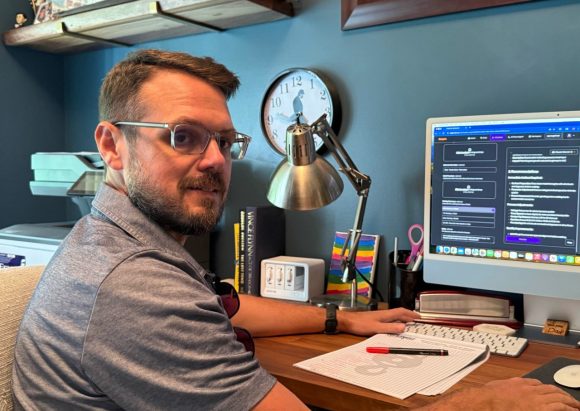
Lloyd Graff writing at his desk at Graff-Pinkert & Co. in Oak Forest. Ill.

Interview with Mitchell Liss, President of Edsal Manufacturing Company, Inc

Mitch Liss, president of Edsal Manufacturing, in front of the company’s plant in Chicago, Ill.

Lloyd and Noah Graff met with Mitchell Liss, president of Edsal Manufacturing Company, Inc., to talk about the issues facing an American manufacturer trying to sell to American distribution outlets and the what it’s like to be one of the largest manufacturers of steel shelving.

Lloyd Graff: Give us a little background on Edsal Manufacturing and your relationship with it.
Mitch Liss:
Edsal Manufacturing opened in the 1950s and now makes industrial shelving and office furniture. The name Edsal came from my father-in-law, whose first name is Ed and whose last name is Saltzberg. At that time he worked for somebody else and was unhappy with how he was being treated, so he decided to go out on his own. He started with about $800 in a small garage and some pretty basic machinery. One of the tenets of his company since day one was to never sell product directly to an end-user, only through dealers and distributors. The company started by making steel furniture, like sewing tables.

LG: Why not sell direct?
ML:
It was his philosophy to build a very strong relationship with distributors. Ed had an engineer’s mind, and I have an engineer’s mind too. We’re not sales people by nature. We have a philosophy that if we build it for the right price, the customers will be there.

LG: Who’s your biggest customer?
ML:
On the industrial side, it’s Grainger. On the consumer side, our two biggest customers are Lowe’s and Home Depot.

Mitchell Liss in his offce Edsal Manufacturing Co.

LG: Contrast dealing with Grainger versus Home Depot. Do they overlap?
ML:
They don’t. The businesses are dramatically different because Grainger has an extreme number of items with low volume [in stock]. Home Depot or Lowe’s might only have three items, but the trucks go out full every day.

LG: Is your brand important to Grainger?
ML:
My personal opinion is that it’s not particularly important. I would say that on a scale of one to 10, with one being a completely generic item to a 10 being like the name GE on lighting, it would be about a four.

LG: Is your brand important to Home Depot?
ML:
More so. On that same scale, it’s maybe a six or a seven. [I say that] because we have done testing in which some of those retailers tried using their own private brand and have lost a significant amount of market share. In fact, around seven years ago Home Depot changed over to their own brand, but in 2009 switched back to the Edsal brand. They wouldn’t have done that if they felt that using their own brand [was working].

LG: Where does Sam’s Club fit into this landscape?
ML:
From my perspective, Sam’s Club is focused on small businesses like restaurants and other target customers who need shelving. You can contrast it with Wal-Mart, where probably 80 percent of what they carry is plastic or resin product. At Sam’s Club there are no plastic shelving units. They place themselves so they’re not competing against one another. I think they have different target customers. Sam’s Club is clearly an important player in the steel shelving market.

Read full article here

Hunting for Copper Treasure

Doug Purtee is a treasure hunter. He rummages though old barns around the Midwest, but his prey of choice is surprising––old copper fire extinguishers. I met him recently at a big craft show in Frankfort, Illinois, where he had his shiny copper fire extinguishers exquisitely stacked, selling for $280 each.

He showed me how they worked and told me his story. He’s semi-retired, but he loves these old Acme and Pyrene extinguishers and has found a market for them as home furnishings. He lovingly cleans and buffs the tarnish off them, and travels the fair circuit showing them off and peddling them. He buys the ugly ones mostly off of old repair guys who stashed them in barns and sheds hoping for the price of copper to rise, or maybe because they were too lazy to call the scrappie.

Doug recently found a hundred of them in a Missouri barn. If they were another metal they would have been oxidized garbage, but because they were pure copper they are readily restorable, like a vintage cast iron skillet.

I have a weakness for these old copper canisters because I used to sell 656 New Britain chuckers to Pyrene and Ansul, so I recognized the brands.

Do I want one for my office? Maybe if he’d give me a deal.

For more information Purtee’s fire extinguishers visit www.vintagefireextinguishers.com

Question: Do you think hunting animals for sport is immoral?

A fire extinguisher polished and fixed up by Doug Purtee

One on One: Chip Ganassi Racing Team Manager Grant Weaver

Chip Ganassi Racing Team Manager, Grant Weaver

Grant Weaver is one of the team managers for Chip Ganassi Racing in Indianapolis. He is in charge of production, purchasing and preparation of subassembly components for Ganassi’s ROLEX GRAND-AM Racing and IZOD IndyCar Series, both 2010 champion teams.

What is a typical piece of pit equipment you’d build in the team’s machine shop?
GW:
We build all of our pit equipment here. We make timing stands, fuel rigs, wheel carts. Everything has to be as quick as it can be, so we try to make everything down to the wheel guns that take the nuts off the race car. We use air jacks—a pneumatic jack to lift the car. We look at every aspect of the car to try to make it go faster or make it lighter.

What’s the difference between Formula 1 cars and Indy cars?
GW:
The cars look pretty similar but a lot more money is spent developing Formula 1 cars. Also, the rule sets are different and the minimum weight of [Indy] cars changes depending on the track, whether it’s an oval or road course or superspeedway. [Indy] cars are around 1,600 pounds empty, while Formula 1 cars are 1,200 pounds. Indy cars have about 650 horsepower, and Formula 1 cars have about 750 horsepower. A Formula 1 car would not be able to race at the Indianapolis 500 because the parts and pieces on it aren’t designed to take the G-loadings and the high speeds.

Is there a lot less contact between cars in an IndyCar race than a NASCAR race?
GW
: In NASCAR, it’s a little easier for you to lean on your friends than it is in IndyCar. In IndyCar, if you touch wheels, one of them is going to go flying. In NASCAR, you can bump a little bit, but the idea is that the cars are so tweaked aerodynamically that if you’re rubbing fenders or banging on somebody, you’re changing your aero and that car might not work as well as it was previously.

Read full article here