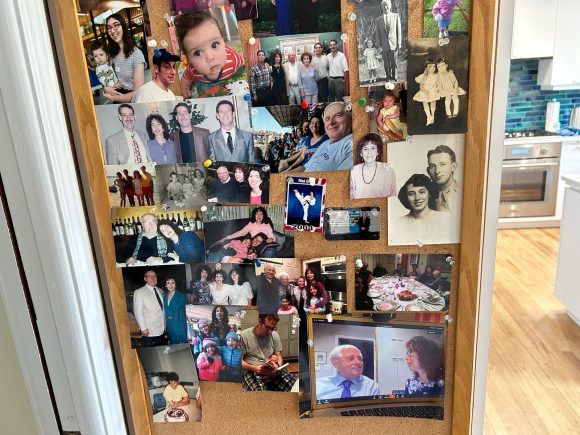
I’ve always looked at the Hallmark holidays of Mother’s Day and Father’s Day with apprehension. It comes from my Dad’s anxious attitude toward his mother, who used the occasion to employ emotional extortion to exact the tribute she expected from our family.
My father lived in fear of her neurotic twists and occasional psychotic breaks. For my own mother, Mother’s Day was her day to nurture my Dad as he tiptoed through the rituals of motherly appeasement.
As a child I observed my parents’ management of Grandma Graff with a combination of amusement and studiousness. It was a lesson in the art of maintaining family peace without admitting the weirdness of our group dance.
I grew up with the dark presence of Ethel Graff at our house every Friday night and Sunday where she would routinely attempt to sow jealously and discontent. She dripped contempt for my mother, who unflappably played three cornered emotional poker with her and my father. One of my grandmother’s more transparent gambits was to ask me and my siblings, “Who do you like more, your mother or your father?”
We would play along, saying we liked them just the same, but in retrospect I wish I would have said, “I’m never going to give you a straight answer to such a ridiculously transparent and stupid question.” But that kind of honesty was forbidden toward dangerous Grandma Graff.
My father occasionally referred to a past Mother’s Day nightmare. His mother was offended one year because she felt her sister-in-law, Ida Pinkert, received better treatment on Mother’s Day than she had (which was quite possible because Ida was clearly a more beloved mother). My grandmother went into a long vituperative tantrum, which eventually led to her hospitalization in a psychiatric ward.
My dad was traumatized by this Mother’s Day spectacular. The holiday became a black mark on his calendar—a day to be navigated around, not embraced.
As a kid I got the scary message without having it explicitly stated. For me Mother’s Day and its cloned cousin Father’s Day, were like Greek Easter to me—holidays other people celebrated.
Question: What comes to mind when you think of Mother’s Day and Father’s Day?
Today’s Machining World interviewed Carl Hoffman, author of The Lunatic Express, a book which chronicles his travels throughout Asia, Africa, South America and the U.S., where he attempted to travel by modes of transportation commonly used by the natives, notorious for discomfort, tardiness and poor safety.
How did you get the idea for the book? Carl Hoffman: I’d been traveling a lot for work over the last decade in places like the Congo, Sudan and South America. I saw minivans and trains just packed with people, and people riding on the roofs of trains. My journalist sensibility was asking me, “who are these people, where are they going and why are they moving around?”
How did these people look at you, as they were traveling out of necessity for work and you were this American traveling alone to document an adventure? CH: They looked at me with incredible curiosity and openness. Most of these people don’t travel alone. They travel with family members. Most people spend very little time in their whole lives alone. They sleep in big piles in a one-room apartment or a shack somewhere, and then they have this incredibly long commute in a crowded minivan or matatu or train, and they have a job that’s full of people. They kept asking me, “Are you alone? Why are you alone? Where’s your family? Why are you here? Why aren’t you traveling in first class, or why aren’t you flying?”
Did you see much manufacturing going on during your travels? CH: Well, one really cool thing throughout the Third World is the amount of small scale manufacturing and small scale human enterprise. In Bangladesh, you can walk down the street and there’s nothing but bicycle rickshaw shops, and guys are welding and banging and doing it in bare feet without shirts. It’s hot, and they’re building things. I had a bicycle messenger bag and its zipper was broken. One day I was just sitting around having tea in the park with some shoe shiners and an ear cleaner that had I buddied up with. One of them suddenly pointed at my zipper and he grabbed my bag and went at it with a little wax from his kit and a razor blade. And with incredible care, he fixed my zipper. It’s the sort of thing that only a poor Indian in a park would do. We don’t fix a zipper. We take it in and send it away, and maybe they send back a new one or they rip the whole zipper out and sew a new one in. This guy fixed it. They have a whole mentality and culture of fixing things and building things, and it’s kind of been lost here.
Why should somebody work as a volunteer in an organization? My wife Risa and I discussed this topic last night as she was considering her last President’s message to the membership of the Association of Educational Therapists, a national professional organization she heads.
Risa has put her heart and soul into volunteering for this organization. She wants other people to follow in her footsteps. My basic orientation on other hand, has always been, “why should I spend my good time on some dumb organization?”
I have no tolerance for group meetings. They put me to sleep. I’ve never been part of an organization that interested me enough to get me to endure the endless prattle of group discussion. I know this sounds hopelessly arrogant, but I’ll admit to being a lousy member. And if you are a lousy member of a group, you will certainly be a terrible leader.
For me, one of the ugliest words in the English language is “committee.” To serve on a committee is to be sentenced to boredom. I may have a little ADD (Attention Deficit Disorder), which educational therapists address in their work, because when somebody inquires if I’ll work on a committee for a charity or professional group, I run for the closest foxhole. To me a board meeting is a bored meeting.
Yet I realize that organizations like the Association of Educational Therapists, the Precision Machined Products Association (PMPA) and the National Tooling and Machining Association (NTMA) do good work and rely on the members input. That means groups, subgroups, and committees. As a member of these organizations I freeload on their efforts. I pay my dues and tune out when members laud other members for the many hours they put in.
I believe the world is divided between the people who like meetings and process and chitchat and sociableness, and the aliens who prefer to be alone or go one-on-one.
If I have the choice of a meeting or Siena vs. Towson State in basketball on ESPN, I’ll choose the engagement with the TV.
Question: If you do boards and committees, what do you get out of it?
The BP disaster in the Gulf of Mexico is a tragic fiasco. Everyone can agree on that, but now that it’s happened, the U.S. government is confronted with the decision of how to go forward.
It has imposed a six-month moratorium on drilling in more than 500 feet of water in the Gulf. President Obama has also put on hold plans to expand drilling off the coast of Alaska.
This decision is based on the claim by environmental groups that we still don’t have a good understanding of why the disaster occurred and what other safety negligence is occurring in other similar wells.
On the other hand, halting offshore drilling salts the wounds of the people in the Gulf region, whose lives are already a mess from the destruction from the spill and recent natural disasters. Many of the people living around the Gulf have jobs in the off-shore drilling industry. The region’s tourism has been crushed, houses destroyed, the livelihood of fishermen stripped, and now drilling for oil, one of the few resources still sustaining the people of the region is being taken away too. Many people are more angry at the government than they are at BP.
One of BP’s main competitors in the gulf, Chevron, has distanced itself from BP and says that a six-month moratorium on drilling is an overreaction because it has much better safeguards for its wells. While this may be true, Chevron recently was involved in an onshore drilling accident involving a Chevron pipeline in Utah that leaked what officials estimated was hundreds of barrels of crude oil into a Salt Lake City creek and threatened to contaminate the Great Salt Lake.
The moral of all this—drilling for oil is a dangerous, dirty game that the government should have been monitoring much more closely. To fix the disaster and attempt to prevent it from happening again will be expensive and messy—kind of like mending the economic debacle of 2009.
Meg Whitman, former eBay CEO, won the Republican primary for governor in resounding fashion on Tuesday. The same day, Rod Blagojevich, former governor of Illinois, watched while his lawyers grilled jurors in his corruption trial.
Blogo’s father ran a numbers game in Chicago. Young Rod grew up in a world of payoffs and married the daughter of a rough local Democratic politician on his way up the political ladder.
Whitman used $71 million of her own dot-com fortune to pave her campaign, while Rod Blagojevich shook down the paving contractors to get his political seed money.
Is Whitman more pure than the driven snow because she was recruited by venture capitalists to run the fledgling eBay after the founder realized he didn’t want to run the business?
Do we prefer the Rockefellers, Heinzes and Whitmans, and maybe celebrities like Arnold and Ronald Reagan, to run our country because the earthy the Rod Blagojeviches are too untrustworthy? Do we only want the elite who go to Harvard and Yale Law on the Supreme Court, which we now will have?
Maybe we want a House of Lords because the raunchy Rods and the slick Willies get too dirtied up climbing to the top.
Question: Do you prefer to be governed by the rich?
Rod Blagojevich and Meg Whitman (Photo from San Francisco Sentinel and Fox News)
I love the “Second Act” column which appears on Tuesdays in the Wall Street Journal. It recounts the stories of people who forsake their original career for one that promises more excitement, opportunity, fun, or satisfaction than the career path they originally pursued.
On June 8, the Journal writer, Dennis Nishi, told John Putnam’s story. Putnam was a successful bankruptcy lawyer in Boston with a firm representing failed airlines and steel mills. While taking a deposition he had an epiphany. “Everyone there was very senior and making serious bucks. That’s when I looked around and [realized] I didn’t want to spend the best part of my life getting to where they are,” the Journal quoted him.
The rest of the story is about Putnam buying a farm in Vermont, taking a job with a Vermont law firm while developing the farm, and then chucking the law to make specialty cheese for a living.
He studied cheese making for four years and bought a custom made copper cheese vat to give his Alpine cheeses a unique flavor. A French student taught him some tricks of the trade in a work-study exchange to use for his graduate thesis.
Putnam started making cheese in 2002 and his business was profitable in 2003. Today his Thistle Hill Farm sells eight tons of cheese a year and is making decent if not great money.
Doing Today’s Machining World is the second act for this used screw machine dealer.
I would like to hear from you about second acts you are now involved in, would like to be involved in, or have tried and given up.
Question: What is your second act?
Jim Block John Putnam (right) and his wife, Janine. (article)
I’m what people would call an “Apple guy.” I only buy mac computers, own Apple stock, and my iPhone and I are inseparable. The fourth generation iPhone was introduced yesterday, and I have to say, I covet it.
In addition to its products being superior in technology and quality, Apple takes pride in its products’ aesthetics, striving to portray them as glamour symbols. Apple’s designers shape their products with the care and sexiness of an Italian car designer. Fittingly, in his key note speech Monday, Apple CEO Steve Jobs even characterized the iPhone as the BMW or Mercedes of phones and its rivals as common sedans. Apple’s marketing team is quite deliberate in its choice of words to describe the company’s products. They say they strive to “produce technology as art form.”
In Apple’s description and video of the new iPhone it boasts that the body of the phone is “CNC machined,” which the company also boasted a few years ago when its aluminum MacBooks debuted.
One of the most successful, coolest companies of our time has just glorified the importance of precision machining. Who knows, maybe the next time I explain to average person what Today’s Machining World is about, I won’t get such a perplexed look.
Question: Do you care that Apple has drawn attention the importance of precision machining?
(Skip to the 5:00 minute mark to watch the CNC machining process)
In this time period between Memorial Day and the 4th of July, I struggle with the idea of patriotism. What does it mean to be an American patriot in 2010?
We honor our soldiers during this period, and they are worthy of praise for their sacrifice and service. But we can legitimately ask if ousting Saddam Hussein has made us safer as a country. Has it been worth over 4000 soldiers killed, thousands severely wounded and untold lives disrupted? I am grateful my children have not ended up in the theatre of war, even while I realize that a draft democratizes the suffering of war.
I watched the Memorial Day concert in front of the Capitol on TV. I was moved to tears by the recitations of loss by the widows of the Vietnam and Iraq Wars. With respect, I ask if either war was worth the sacrifice of so many young people.
There is a time to fight for freedom. World War II was a life and death struggle with evil. But I think it is also patriotic to question why American kids volunteer to suffer, and kill and be killed in jungles and deserts year after year. Are we safer from their enormous sacrifice? Maybe we are. But I think the answer is far from clear.
Question: Have the wars in Iraq and Afghanistan been worth fighting?
For almost 10 years I’ve lived the schizoid life of a machinery dealer and writer/publisher. Both jobs stoke my intellectual furnace with firewood. I feel like I’m usually on top of my game in my writing because the more I do the sharper the prose gets. As a deal maker, I sometimes feel like I’m half a lap behind.
The skills of deal making resemble those of writing a journalistic piece. Both require research—acquiring the facts from disparate sources. On the machinery side I am constantly looking for sources to provide me with solid comparisons of values. Is a four-year-old Mazak 30” x 16” vertical machining center worth $25,000 or $45,000? The difference in value may hinge on a change of controls, a choice of options or the hours on the spindle. Another variable affecting the price is the quality of Mazak service, availability of spares or whether the dealers are discounting at the moment.
The day after Memorial Day weekend I pose the question, “Should we be economic patriots”?
When I wrote the car buying stories for the April and May TMW issues, I took heat from readers who felt I was derelict in not coercing my sons to buy American cars rather than Hyundai Sonatas.
It turns out that the Sonatas are made in Montgomery, Alabama, and have more than 50 percent American content. Hyundai spent $1 billion to build a factory, and the workforce is almost entirely Alabaman, but ultimately, my sons’ buying decisions were based entirely on the products and price. Economic patriotism had nothing to do with it.
I ask you my readers, do you buy a Haas vertical machining center because it is American or because it is the best machine for the money? Do you pass on bananas because they come from Honduras? Do you shun an iPhone because it was made in China at a FoxComm plant that has had 10 suicides among its workers this year. Where does your economic patriotism start or end?
Personally, I am not an economic agnostic. I have never considered buying a German Mercedes or BMW, because of the Nazi atrocities of 70 years ago. But considering most of the taxis in Israel are Mercedes I know that economic discrimination is now ridiculous.
Many of my long time screw machine customers have shops in China now. Are they economic Benedict Arnolds?
I recently talked with Joe Arvin who owns a big aircraft gear company near Chicago. He considers himself an economic patriot because he will not put up plants in China even though his clients are pushing him to do it.
Do you think our soldiers died for Ford or for allowing us the opportunity to use our economic and political freedom to buy oil from Saudi Arabia to drive our BMW to the sushi restaurant?
Question: Do you consider yourself an economic patriot?