
The Wizard of HAAS

Gene Haas

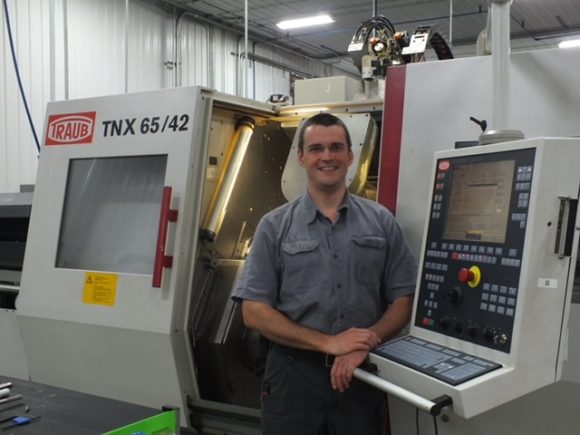
Gene, how did you get into this business?
When I was in high school I worked in a machine shop. I started out sweeping fl oors. This is before child labor laws I guess; I was only 13 or 14 years old.

Did you take engineering in college?
I went into engineering when I first got to California State University of Northridge. I was in engineering for two years until 1972, around the time Lockheed almost went bankrupt. It seemed like maybe engineering wasn’t the degree to be in, so I switched over to business.

Where did you go from there?
They did placement at college, and after I got my degree they found me a job. It was going to pay something like $720 a month. I was making $300 or $400 a week as a machinist, so I just went back to working at a machine shop.

I actually had a job for six months as a programmer at Seaton Wilson, and I was programming the old fashion way – this is even before computer systems came along. It was at one of those fundamental turning points in the whole industry. When I started learning how to make parts in the machine shop, I ran a Hardinge Chucker and a Logan lathe, which were manual machines, and I was making parts one at a time. You put stock in the collet, and you feed the thing; you turn that diameter and then go to another dimension and put a groove in – that’s how parts were made. I was probably in my 20s doing all this and going to college and found it wasn’t easy to get a job. Around 1976, I decided to get a job using numerical controls.

Read full article here

America’s Back on Track

I was talking with a client recently who was happy to relate how his company was doing. The firm makes brass and steel fluid handling hardware sold at big box retailers and through industrial distributors worldwide.

The company had six plants, three in the U.S. and three in China, but has closed one in China and is in the process of closing a second. The cost advantages of making product in China have eroded. The strength of the Yuan currency, quality challenges, supply chain interruptions, and the human cost of running people back and forth has caused them to pull manufacturing back to the U.S.

The one plant that they are continuing in China does casting work, which still makes sense because the environmental hurdles for such work in America are too bothersome and expensive to deal with.

The American plant my client runs produces about $100 million worth of product, much of it run on machines like Davenports and Acmes. He employs 150 people. He says it would take 1500 workers in China to turn out a comparable amount of turned products.

 ********

I know most people were sickened by the debt ceiling brouhaha in Washington, but I was mesmerized by it. The corralling of the budget deficit issues in America is worthy of the drama. Cutting government spending and deciding whose ox will be gored will be the big political issue of the next few years, and it is worth fighting about. I laughed and then grimaced at the rise of the Tea Party and its over-the-top rhetoric, but now I salute them. The Tea Partiers moved the country and showed what a determined minority can accomplish if it stays on message and adheres to discipline. The Washington establishment blinked over the weekend and real change happened.

We recently watched the “Arab Spring” begin to unfold, portending significant change in the Arab world. What just took place in D.C. may be the small beginning of Americans taking control of Government Gone Wild.

*******

Another hopeful development coming out of Washington is a shift in the policy regarding immigrant entrepreneurs and immigrant “brains.”

The ugly anti-immigrant bias, which rippled though the Bush Administration after September 11 and continued into Obama’s Organized Labor homage, is now changing. According to an August 2 article in the Wall Street Journal Alejandro Mayorkas, Director of U.S. Citizenship and Immigration Services for the Department of Homeland Security, is implementing several new initiatives to bring in foreign entrepreneurs, particularly in the high-tech sector.

In recent years, software entrepreneurs in particular have obtained their education here and then been forced to take their business startups elsewhere because they could not get a Green Card. Hopefully visas will now be easier to come by.

There is also a new initiative to allow foreign investors to get visas if they invest $500,000 in a new business that employs at least 10 people. At the time that Canada initiated a similar program in the late 1990’s people in Hong Kong were scared about their future under Beijing rule. A tremendous rush of money came into Vancouver, and Canada is still reaping the dividends of that opening. Look at the Canadian dollar versus the American currency now.

For the first time in a while I’m starting to feel optimistic that a broken government can be mended by the will of the people.

Question:  Do you think America is moving in the right direction?

Alejandro Mayorkas, Director of U.S. Citizenship and ImmigrationServices for the Department of Homeland Security

Ethics: Working For Your Former Rival

I think I made a huge mistake. I left my job of 12 years to join a rival across town. The two companies compete for the same work and use many of the same vendors. While shooting the bull with my new co-workers, I thought I’d “raise” my stock in their eyes by revealing “inside” information about my old employer. I bragged about some special fabrication techniques, and I mentioned a little trick we played with U.S. Customs that saved my old company a bundle when it came to classifying some imported material. Everyone was impressed, but now my new boss wants to drag me to the customs office to spill the beans on my old gang, who I still really like. He’s also expecting me to reveal everything I learned over 12 years. I don’t know that they’re doing anything wrong with customs, but the investigation will be a hassle, and everyone will know my new company is behind it. I’ll look even worse when my former employer sees that my new employer finally solved a production problem using a process we used at the old shop. I feel sick about it, like I’m Benedict Arnold.

Since the “damage” is already done, what’s the ethical dilemma; whether or not you should continue to beat yourself up for enhancing your status at the expense of your old company? Who are you worried about – the people who may now regret not keeping you? Before you whip yourself raw, ask yourself what you’ve really done “wrong.” Assuming you’re not under some sort of confidentiality agreement or trade secret situation, your guilt bag is a product of loyalty which you no longer owe. This isn’t to say that you shouldn’t harbor respect and admiration for the old gang, but you’re now in competition with them, and the information you revealed is fair ammunition in the business world.

Read full article here

Lebron James and Chris Bosh in Uniform of Their Former Rival Team

How it Works – The Line on Linear

Electric motors go around and around, right? Not necessarily. About a hundred years ago, the idea of a linear motor was conceived—a motor that directly produces straight-line motion, rather than rotary motion. Over the years, inventors and engineers developed many different types of linear motors, suitable for many kinds of applications. You’ve probably seen machine manufacturers touting products with “linear” in the name, as these unusual motors have begun making their way into machine tools in recent years.

How a linear motor works
The familiar type of rotary motor depends on magnetic attraction to make the shaft rotate. Magnets located around the circumference interact with the magnetic fled produced by windings affixed to the shaft, which pulls the windings around and makes the shaft turn.

You can think of a linear motor as the same thing—magnets and a coil. But they are “unwrapped” to lie fat. There is a fixed component (called the track, platen or secondary) and a moving component (called the forcer or primary).

In this type of linear motor, the track, or fixed component, contains a series of permanent magnets laid side by side along its length, and the moving component contains electrical windings. When current flows through the windings, the resulting magnetic fled engages with the fled from the magnets in the track, causing motion. You can increase the length of the motor simply by adding more fixed sections. In one machining application, the linear motor was 100 feet long.

Read full article here

Failing Admirably

We were visiting my daughter and son-in-law in Palo Alto and wanted to celebrate life by going to their favorite restaurant, the Flea St. Café, in Menlo Park. We had a wonderful meal and wanted to top it off with dessert.

Everything at this establishment is made with in-season local ingredients. We ordered blackberry pie, blueberry panna cotta, and angel food cake with fresh strawberries to share. The menu said that the angel food cake had the herb thyme in it, which seemed absurd, but my wife wanted angel food cake so we ordered it. The waiter had actually tried to steer us away from that selection but we thought it was because it seemed like a boring choice for such a topnotch eatery.

The cake was terrible with the bitter herb killing the normally benign flavor of the fluffy white dessert. But after finishing every last crumb of a wonderful meal, except the angel food cake, it struck me that this restaurant was good enough and confident enough to do something ridiculous like put thyme in their angel food cake. I can gladly forgive them for the miss because they tried for a home run where anybody else would settle for a single. The restaurant excelled because the proprietor would not settle for nice.

I remember a restaurant owner telling me the worst answer from a patron to the question, “how was your meal?” was, “it was fine.” “Fine” to a good manager means the meal was “forgettable” and “I’m looking for someplace better.”

What I will remember from the Flea St. Café is that I had a great meal. I can heartily recommend it partly because they took a chance on the thyme and struck out.

There is a lesson for us even in the land of machinery and perfect parts. If your product is outstanding and you occasionally overreach or goof up, the customer will tolerate it, maybe even laugh about the fact that you spilled the soup. But if you are just okay and screw up on the hamburger, he will start looking for an alternative. Creativity is a virtue even if it fails, when the core product is outstanding.

Question: Please share a story about a failure of yours or someone else’s that for good reasons or bad, is unforgettable to you.

How It Works – Dry and near-dry machining

Everybody in the business has used flooded coolant practically forever and knows that it works. They are probably also aware that it has its drawbacks, including:

• The cost of buying, maintaining and disposing of cutting fluid, which is estimated to account for 7 to 17 percent of the cost of machining parts.

• The need to clean parts after machining and to remove as much fluid as possible from chips before recycling

• Health problems from handling or working around conventional coolants include skin irritation or allergic reactions, asthma, bronchitis and other respiratory difficulties. It’s possible that long-term exposure to some coolant additives could lead to cancer.

Competitive cost pressures and increasingly stringent environmental and occupational health standards are inspiring some shops to seek ways to minimize or eliminate their use of cutting fluids. They are finding that dry machining, “minimum quantity lubrication” (MQL) and other techniques offer benefits far beyond simply reducing their cutting fluid costs.

Advanced cutting tool materials, coatings and designs, along with a variety of strategies for lubrication, cooling and chip removal, make it possible to achieve the same or better results with dry or MQL machining: shorter cycle times, better surface finish, longer tool life, and higher recycling value for clean chips.

Dry machining then and now

Some materials have always been machined dry – magnesium, for example. It reacts with water, so common coolants are incompatible with it. PGM-New England, a Manchester, NH, contract manufacturing and assembly company, machines many materials with flood coolant, but it dry machines magnesium for small-aircraft oil pans and other parts. “We’ve had very good success with [magnesium]. It machines very nicely,” said PGM general manager Nick Baldassara.

Read full article here

New Thinking Inside The Box

Sal Khan was a math wiz and wanna be entrepreneur who moved to Silicon Valley after graduating from MIT in 1998. After the dot-com bubble burst in 2000 he knocked around the valley looking for the next big thing. He got into the hedge fund racket in the mid 2000s.

In 2006 he got a call from a cousin in New Orleans where he had grown up. She was having trouble with Algebra and wondered if cousin Sal could tutor her long distance. Sal jumped at the chance to teach a little math and recorded a 10-minute video on the topic and posted it on YouTube. His cousin loved it and asked Sal for more help and Sal made more videos for YouTube. The lessons caught fire on the Internet channel and all of a sudden people from around the world were learning Algebra from Sal Khan in 10 to 20 minute lessons on the Web.

Sal quit his day job (his wife is a doctor) and started making more videos for the newly named Khan Academy. Everything was free—and the educational and philanthropic community was taking note of what was going on as Khan was piling up viewers from Green Bay to Calcutta (where his parents came from before ending up in Louisiana).

The Bill and Melinda Gates Foundation put up $2 million for seed money, which now helps fund him and a dozen associates. Khan has made a point to steer clear of the educational establishment, but amazingly to him, the progressive Los Altos, California, school system is partnering a hybrid approach which allows kids to use his videos as part of the math curriculum.

For tutors and home schoolers the Khan Academy is a godsend. The lessons are in digestible chucks, available anytime, and are free. Sal Khan is changing the world, one 10-minute video at a time. And that cousin from New Orleans just finished her freshman year at the elite Sarah Lawrence College in New York.

(Much of this information came from a Chris Kendrick article in the Palo Alto Weekly.)

Question: Do you have any experience with homeschooling?

How It Works – Getting a GRIP

Sure, any old vise can hold the part on a machine table, but a well-thought-out workholding scheme can help you squeeze more chip-making time out of every shift.

Certain basic principles apply to workholding, whether you’re using your father’s 6-inch manual Bridgeport vise or an intricate hydraulic fixture. Dr. Edward De Meter, professor of industrial and manufacturing engineering at Pennsylvania State University, University Park, Pa., does research on workholding. He outlined the basic functions of any workholding method as follows:

  • Repeatably locate the workpiece with respect to your data reference frame.
  • Restrain rigid-body motion of the workpiece—hold it down so it doesn’t fly off the table.
  • Impart overall structural rigidity—prevent the fixture and workpiece from being a source of chatter.
  • Hold the workpiece without excessively distorting it.
  • Accommodate dimensional variability in the raw workpiece —often an issue with castings, forgings or weldments.

Abrasive diamond grippers from Fixtureworks hold smooth or slippery workpieces with minimum clamping pressure.

Many types of workholding devices, from simple collets and vises to complex fixtures, will perform these basic functions. But “workholding is not just holding the part,” said Wendy Kuch, product manager at Chick Workholding Solutions, Warrendale, Pa. “It’s a significant part of efficiency [in your machining  operation].”

The workholding method is part of your whole machining system: the machine, the tool, the program, the operator and the workholding. All the parts have to function together in an effective way if you’re going to make the most profit from your machines. The key is maximizing the work you’re being paid for: removing material—making chips. To do this, you optimize the tooling, feeds and speeds. You’ll also want to minimize the amount of time the spindle is idle. That’s where your workholding choices can pack a big punch.

In the new workholding scheme, three Chick Pneu-Dex four-sided indexers were mounted on the machine table. Two workpieces were clamped in vises on each face of the Pneu-Dex units. These vises allowed machining of three surfaces of a clamped part.

An Interview with Jack Schwietert of V-S Industries

Today’s Machining World Archives October 2006 Volume 02 Issue 10
Lloyd Graff:   We’re with Jack Schwietert of V-S Industries to talk about manufacturing in Mexico. Jack, when was the decision made to establish an operation in Mexico?
JS:  The decision was made in 1993. At that time, we were supplying a customer who had multiple plants in the states. They gave us an award for being their best supplier. One of the fellows I was dealing with asked me, “Have you ever considered putting a shaft manufacturing facility in the Southwest? When I said no, he said, “Our largest client is a motor manufacturer in Juarez, Mexico. We actually supply the shafts to this plant ourselves. We did a study recently and discovered we’re our own shaft suppliers. We’ve been working to resolve that but to no avail.”

The plants that they had here were very inflexible union plants, and probably did not like the idea of supplying to Mexico.  He said they found a lot of good metal turn companies in the Southwest, but they seemed oriented around defense industries making 15 perfect parts a week. When you asked for 30,000 parts a week, they just couldn’t conceive how you would even do that. They wanted to see if we were interested in starting a facility down there.

Now when I worked for 3M, I would visit an engineer friend of mine who took me to their Maquila facilities in the Tijuana area. I met people he dealt with and always kept a file on Maquilas. We decided we would go down there. I didn’t know how to conduct business in Mexico. We decided we needed a Maquila operator who would shelter us and take care of the payroll. Our customer actually became our shelter operator, and we operated for the first year and a half of our existence down there in the plant of our customer, with him supplying our workers. We told him how many people we needed, he took care of the payroll and at the end of the month, they would give us a bill for how many hours we had used. After a year and a half we hired Carlos Castel, the fellow who ran our operation in their facilities. I hired him away from our customer with their approval. We had written into our contract that we could go out and deal with other customers, but I never felt that was appropriate as long as we were under their roof.  Their business increased, and they needed the space.  We wanted to do work with other customers.  We moved into our own Juarez facility in January 1996.  We now have four other customers down there. It’s very low volume, quick turnaround, and high value-added business, exactly what you want in Mexico.  The only thing that’s really cheaper in Mexico is labor. The building in Juarez is every bit as expensive to lease or own as it is in El Paso. The power is probably more expensive. The work rules are probably more restrictive in Mexico. Juarez is part of the State of Chihuahua, which is a very conservative state. That’s where the PAN party started. We are non-union, but that’s a little unusual in Mexico. Most places in Mexico are union companies but are considered “white,” meaning friendly unions.

Read the full article here

Compassion of a Navy Seal

President Obama isn’t the only one who got a numbers bump from the recent killing of Osama bin Laden. Books about Navy Seals have been flying off the shelves. One very good one is The Heart and the Fist by Eric Greitens, a Duke and Oxford educated Rhodes Scholar turned Navy Seal turned humanitarian volunteer.

The Heart and the Fist is quintessentially American. Greitens combines the warrior ethos of toughness and courage with the compassion of a humanitarian.

He starts with conversations with his grandfather, a decorated hero of WWII, and his reflections on the Holocaust, and the mantra of “never again.” But the reality is, it does happen again and again and again. During college Greitens volunteered in Rwanda, Bosnia and with Mother Teresa. He saw that the UN had no real power. They could only bring aid when the guys with the guns allow it. The UN can’t protect anyone—just ask those victims of Srebrenica. He saw that it takes strength and courage to move from good words to great action, and to protect those in need of protection.

After graduating from Oxford, Greitens joined the Navy Seals. The book provides a rare first hand account of the intensive Seal training, culminating with “Hell Week.” My nephew Aaron, who retired from the Seals a couple of years ago confirms Greitens’ account. Seals train men to lead others on the most difficult missions and they succeed.

Greitens served four tours in Iraq and Afghanistan. After returning, he used his own combat pay and the disability pay of two friends to start “The Mission Continues,” an organization whose mission is to build an America where every wounded and disabled veteran can serve again as a “citizen leader.” The organization provides fellowships for post 9/11 wounded veterans to work in community-based non-profit organizations. Mentors are provided to assist the vet in developing his or her professional and educational goals.

Greitens maintains that courage and compassion are two sides of the same coin. To live a worthy life requires that we be both good and strong.

Question: Do you feel safer after Bin Laden’s Death?