Economic Patriotism

By Lloyd Graff

The day after Memorial Day weekend I pose the question, “Should we be economic patriots”?

When I wrote the car buying stories for the April and May TMW issues, I took heat from readers who felt I was derelict in not coercing my sons to buy American cars rather than Hyundai Sonatas.

It turns out that the Sonatas are made in Montgomery, Alabama, and have more than 50 percent American content. Hyundai spent $1 billion to build a factory, and the workforce is almost entirely Alabaman, but ultimately, my sons’ buying decisions were based entirely on the products and price. Economic patriotism had nothing to do with it.

I ask you my readers, do you buy a Haas vertical machining center because it is American or because it is the best machine for the money? Do you pass on bananas because they come from Honduras? Do you shun an iPhone because it was made in China at a FoxComm plant that has had 10 suicides among its workers this year. Where does your economic patriotism start or end?

Personally, I am not an economic agnostic. I have never considered buying a German Mercedes or BMW, because of the Nazi atrocities of 70 years ago. But considering most of the taxis in Israel are Mercedes I know that economic discrimination is now ridiculous.

Many of my long time screw machine customers have shops in China now. Are they economic Benedict Arnolds?

I recently talked with Joe Arvin who owns a big aircraft gear company near Chicago. He considers himself an economic patriot because he will not put up plants in China even though his clients are pushing him to do it.

Do you think our soldiers died for Ford or for allowing us the opportunity to use our economic and political freedom to buy oil from Saudi Arabia to drive our BMW to the sushi restaurant?

Question: Do you consider yourself an economic patriot?

French Fries Fuel Machining Business

By Lloyd Graff

Here’s the good news and bad news everyone. Bad news—75 percent of Americans are overweight. We’re French frying ourselves to death. Good news—it’s going to be great for the precision machining business.

Dr. Uli Sutor, key account manager at DMG, gave an illuminating talk at the first day of DMG/Mori Seiki’s Innovation Days, May 24, at its national headquarters in Hoffman Estates, Illinois. The event was a combination sales and networking event for the collaboration between two of the biggest players in the world machine business.

Sutor’s presentation discussed the opportunities in the medical machining business. As he sees it, orthopedics, primarily knee hip and spine are the biggest segment. The passage of Obama’s healthcare plan in the U.S. will expand the area even faster. According to the literature it takes 40 minutes to do a knee replacement—20 if there’s no insurance.

A person who is at least 30 pounds overweight is three times more likely to need a knee or hip replacement than a trim person. It’s easy to see that the trend is the friend of orthopedic surgeons and hospitals.

Sutor mentioned the number of bone screws and plates produced in the world. His number astounded me—200 million orthopedic screws and plates last year.

Last year 1.1 million knees and hips were replaced in the U.S. The expectation is 4.6 million per year by 2030, partly because a joint replacement lasts 10-12 years so there will be a lot of redos, especially if the obesity trend continues.

Dr. Sutor gave the presentation from the DMG point of view. He employed a lot of data from the European perspective. One piece of information I found valuable was that “turbo whirling” is now being made by DMG for bone screw threads. The process employs linear technology which uses no gears or belts and provides a superior surface finish. This is particularly valuable if a doctor will eventually remove the screw from the repaired joint.

Question: Who makes your favorite French fries?

Ganesh Grows Again

Ganesh Machinery was founded in 1985 as a machine tool distributor selling manual lathes and milling machines from a 1200 sq. ft. facility in Chatsworth.  The following year Ganesh started doing CNC retrofits of knee mills and added Teach-Lathes to their product line-up.  By providing superior customer satisfaction and customized manufacturing solutions with their full line of manual and CNC lathes and milling machines, Ganesh has been able to grow their business into a countrywide provider of sophisticated machine tools. Business growth has necessitated adding an additional 7000 sq. ft. showroom just to house their extensive manual machine tool line. Ganesh now markets a full line of  machine tools from their expanded 22,000 sq. ft. facilities, with headquarters in Chatsworth.

Now celebrating their 25th Anniversary, Ganesh has introduced the new 8-axis Cyclone TTMY-52 CNC lathe for complex 2” diameter bar work that will be displayed at their open house on July 20th at 20869 Plummer. St, Chatsworth, CA.  Phone 888-542-6374.

View from the Border Patrol

By Noah Graff

(From the Archives Nov. 2006) TMW interviewed T.J. Bonner, president of the National Border Patrol Council, a union that is part of the American Federation of Government Employees, about his dual role in thwarting illegal immigration while advocating as a labor leader.

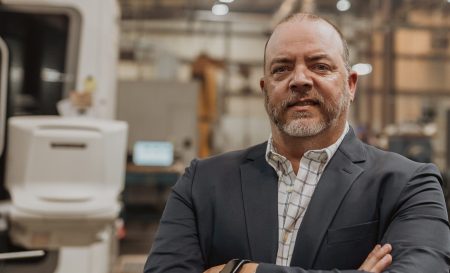
Photo of T.J. Bonner, President of the National Border Patrol  Council and border patrol agent.

Photo of T.J. Bonner, President of the National Border Patrol Council and border patrol agent.

NG: Hi, T.J. CAN YOU BEGIN BY TALKING ABOUT WHAT YOUR JOB ENTAILS AS A BORDER PATROLLER AND AS THE PRESIDENT OF THE NATIONAL BORDER PATROL COUNCIL?
TB: As a Border Patrol agent I’m responsible for securing the border, stopping everything that comes across the border. Obviously we’re not successful in that. We have millions of people in the country illegally, although it’s estimated that at least a third of the people or perhaps 40 percent of the illegal alien population in the United States are overstays. They come to this country legally but overstay their welcome. My other job, as president of the National Border Patrol Council, consists of the traditional things that labor leaders do – collective bargaining, representing the interest of the employee, as well as speaking on behalf of the employees in the media and lobbying on their behalf in the halls of Congress.

NG: ARE YOU ACTUALLY STATIONED AT THE BORDER?
TB: The Border Patrol of late has been consigned to the border. We have a few stations that are in what’s called the interior, but most of our stations are right along the border.

NG: WHAT MADE YOU WANT TO BECOME A BORDER PATROL AGENT?
TB: Seemed like an interesting job. I had an interest in pursuing a law enforcement career and had an application in with the Los Angeles Police Department. I was living in Los Angeles at the time, and had seen the Immigration and Naturalization Service special agents working in the same factory I was working in. They didn’t have any openings for criminal investigators but they did for border patrol agents. I entered with the thought of using that as a stepping stone, but fell in love with the job and have been here for 28 years.

Read the full article

Admitting You Screwed Up

By Noah Graff

A BP cleanup crew removes oil from a beach at Port Fourchon, Louisiana. (Getty Images)

A BP cleanup crew removes oil from a beach at Port Fourchon, Louisiana. (Getty Images)

When is it best to take responsibility for a screw-up, even when you think it’s not entirely your fault?

Recently NPR’s “Morning Edition” interviewed Patrick Kinney of Gaffney Bennet Public Relations to get his thoughts on BP’s current public response to the Gulf oil spill. Kinney had worked for Ogilvy Public Relations, which helped BP rebrand itself as “Beyond Petroleum” 10 years ago.

At the beginning of the oil spill crisis BP’s PR team elected to deny responsibility for the disaster. However, later the company flip-flopped and admitted it was at fault. Kinney attributes BP’s first response to its lawyers who were in the “hide from liability” mindset. Whether the company is entirely responsible for the crisis or only partially, it realized that it was best to take responsibility for the mess, because the world wouldn’t rest until someone took the heat. Denying responsibility would only make the public’s resentment for the “evil, polluting, greedy oil company” escalate even more.

Another method the company is trying in order to defuse the public’s resentment is keeping people up to date on the status of the crisis using Twitter, Facebook and video updates on its Web site. Kinney says that along with using these information outlets, it’s important for BP to tell the public about the questions it doesn’t have the answers for and tell people why that is.

Of course there is the distinct possibility that BP is attempting to make the public think it is being transparent when in actuality it’s all big façade so the company can discreetly withhold the really dirty stuff. I wouldn’t put that tactic past them.

Kinney says that that BP’s CEO, Tony Hayward, will likely lose his job from the crisis. He’s a convenient scapegoat and his own public response that, “the amount of oil spewing is tiny in comparison to the amount of water in the Gulf,” is not what BP needs coming from the face of the company. Kinney says that in crises such as this one, 11 out 12 CEOs lose their jobs.

Question: Have you ever taken responsibility for a screw up that wasn’t totally your fault?

Click here To listen to the NPR Story

Delmar Cengage Learning Photography Contest

NIMS’ publishing partner, Delmar Cengage Learning, is looking for a visually exciting image to use as the centerpiece of the cover for Precision Machining Technology, our soon-to-be-published machining fundamentals text.

Here’s what they’re looking for:

  • A colorful digital photo showing a close-up of a machining operation
  • Ideally, the machining operation will fall within the scope of the text’s contents (see list of sections below)
  • The image provided should be high-resolution, at least 1800 x 1200 pixels (6″ x 4″ at 300 DPI)
  • The image must be accompanied by a short caption (5 – 15 words) identifying the operation and explaining its significance

Rules:

  1. One image per entrant – pick your best shot!
  2. Images submitted must be the property of the entrant

Entries should be sent by email to benjamin.gleeksman@cengage.com not later than midnight, June 4, 2010. Include your mailing address and home telephone number.

The winning image will be licensed for use on the cover of the text, which will be unveiled at SkillsUSA’s national conference, starting on June 21, 2010. The winner will receive a check for $500 and a credit line in the text, along with the thanks of the authors, the publisher and NIMS.

Contents:
Section I – Introduction to Machining
Section II – Measurement, Materials and Safety
Section III – Job Planning, Benchwork and Layout
Section IV – Turning
Section V- Drill Press
Section VI – Milling
Section VII – Grinding
Section VIII – Computer Numerical Control (CNC)
NIMS
email: cross@nims-skills.org
phone: 703-352-4971
web: http://www.nims-skills.org

Sandvik Coromant Hosts Advanced CAM Programming Training Course for Aerospace

Sandvik Coromant continues its dedication to its customers’ success by hosting an Advanced CAM Programming training course at its Aerospace Application Center in Fair Lawn, New Jersey from July 19 – 21 and November 1 – 3, 2010.

The three-day class is designed specifically for experienced CAM programmers in the aerospace industry who are looking for ways to improve machining processes and profitability. The course will focus on programming techniques in Unigraphics NX6 software and allow attendees to learn the secrets to efficient, cost-effective machining and programming of exotic materials from industry-leading specialists.

Methods covered include: milling of Inconel square block, Inconel scallop milling, titanium and Inconel turning, 2D pocket milling and casing. For each method, course instructors will discuss cutter path theories, compare metal removal and tool life, conduct hands-on machine demonstrations and implement programming paths.

Though class size is limited, Sandvik Coromant may elect to add more courses to the calendar if demand continues to be high. To register, please call 201.794.5108 or email us.training@sandvik.com.

Tough to Get Containers

By Noah Graff

The Street.com recently interviewed John Maccarone, CEO of Textainer, a company that owns and leases more than 10,000 containers. According to Maccarone, there will be a huge shortage of containers in the coming years. The capacity of world containers declined last year because all of the container manufacturers had closed. The closings caused the companies to lose a ton of skilled labor, so now their output is less than half of what it would be in normal years.

According to Maccarone, global trade is forecast to grow by 9-10 percent next year, in contrast to 2009 during which it declined by 10 percent. Presently containers are at a 90 percent utilization rate.

Tough to get enough containers, but at least we need them.

Watch the video to learn more.

Sandvik Coromant to Sponsor a Car at Meijer 300

Sandvik Coromant will sponsor a car at the upcoming Meijer 300 at Kentucky Speedway on June 12, 2010. The NASCAR® Nationwide® Series race is the 14th of the 2010 season.

Sandvik Coromant is also a technical partner of Joe Gibbs Racing. The world’s leading producer of cutting tools has supplied the storied NASCAR franchise with effective, high performance metal cutting solutions for more than eight years.

Sandvik Coromant is a world-leading supplier of cutting tools and tooling systems for the metalworking industry and is represented in 130 countries. 25 state-of-the art Productivity Centers located around the world provide customers and staff with continuous training in tooling solutions and methods to increase productivity. Sandvik Coromant is part of the Tooling business area of the Sandvik Group.

Anniversary Ideas

By Lloyd Graff

This weekend I’m celebrating my 40th wedding anniversary with my wife Risa. We’re spending the weekend in Chicago, having dinner with our children tonight and catching a play on Saturday.

Does anybody have a suggestion for a unique and memorable way to celebrate a milestone occasion like a 40th?

My wife is not into helicopters or blimps. We are foodies to some degree but we both have some dietary restrictions. Cubs are out of town.