

Observations of the machining business at mid-year.
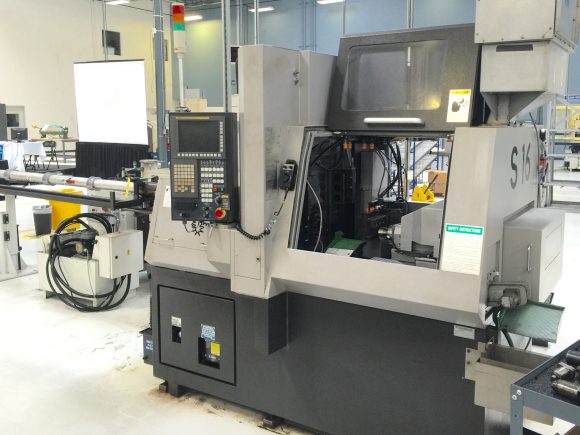
There seems to be a real case of the blahs in the market. Auctions from the wreckage of the domestic frackers are swamping the Southwest. Waves of 10-year-old CNC lathes and mills are hitting the market and depressing prices. Haas VF-2 and VF-3 machines, market staples, have softened 20% in the last year. Even the CNC Swiss market which has been strong for so long is softer, partly because the Japanese Yen’s weakness versus the dollar has enabled new machine sellers to discount. The total market has also eroded with ferocious worldwide competition in the orthopedic arena. I attended an auction in San Diego recently where Tsugami 20mm Swiss CNC machines, early 2000 vintage, sold for under $20,000 each, while 2008 and 2009 machines were in the low to mid $30,000 range. The Swiss machines ran only medical and were in decent shape but had a lot of hours on them.
I would say this shows a clear weakness in the used Swiss CNC market.
******
It is such a cliché to write that the world is getting smaller, but certainly the machining world is compacting. A lot of companies are going out of business. Baby boomers are finishing their runs, some are selling out, others closing up shop, and many are being forced to shut the doors. There are not a lot of start-ups to replace the casualties.
But I see another interesting phenomenon as the Boomers fade. There is very keen interest by successful foreign firms, primarily European, to invest in American metalworking businesses.
For many successful European entrepreneurs, the U.S. looks like low hanging fruit compared to other growth markets like China, India and Southeast Asia. Certainly, China has potential, but the bureaucratic hurdles are formidable and India is still a mess for a foreigner. In the European’s sight the U.S. is so much easier to navigate and generally hospitable to foreign investment.
We find that European entrepreneurs usually know English or have trusted associates who are fluent. The language barrier for China is much higher. It is much easier to recruit people from the home plant to work in America than putting down roots in Shanghai.
If they are in automotive related industries, it is likely that their European customers are already entrenched in America. The standards for machine operation in Western Europe are very high. If they can install European quality standards in an American machine operation they believe they can be successful.
The obstacles for American companies starting up in Europe are seemingly much more formidable than vice versa. Finding property, establishing a workforce, understanding the bureaucracy are quite difficult for an American entrepreneur determined to settle in Paris or Rome.
The intrepid Europeans are hunting for investments all over the U.S. From my vantage point, a lot of them like the Midwest because of good infrastructure and access to skills. Both coasts look very expensive, and the South still seems to be light on skills for European machining entrepreneurs. Perhaps Charlotte, Houston and Dallas are exceptions.
The 20% reduction in the value of the Euro appears to have stabilized, so the currency situation appears to have little impact on decisions. The world market in automotive, consumer and medical components is amazingly homogenized. Everybody is competing one way or another in a world marketplace.
There will be a lot of opportunity and plenty of heartbreak. Americans will all have to get sharper to stay on top.
Questions: Should there be an Iraq War Memorial? Should the war have been fought by Americans?

6 Comments
Thanks for your report, Lloyd. It’s thought-provoking information and hints at large-scale implications.
There should be a memorial, there shouldn’t have been a war.
The impact of foreign investment in US firms has always made me uncomfortable. In fact, I read one article a couple months ago that indicated that the majority of all manufacturing growth in the US is from foreign investment ALONE. While I think it is a generally positive sign that European and Asian entrepreneurs find the US economy and its companies strong enough to warrant investment, I believe it is troubling that these transactions are taking place in lieu of direct domestic investment. What does this say about the wealth of the US citizen and the future of American-owned business if the only people willing to buy our assets are those who come from overseas? I don’t believe this is a sign of a prosperous nation.
The people who served there deserve the same respect any veteran of a foreign war earned. They were shooting real bullets and their injuries and loss of life is just as real as WW1, WW2, Korea, or Vietnam. These people didn’t ask if we should be there, they did what they thought was their duty.
Period,
ed
I agree Ed. They gave their lives in the name of the same principles. Whether the war was a poor choice should not be an issue.
We debated a while about the question for this blog. For a while we thought about asking “What was the stupidest war that the U.S. was involved in?” But we decided that it was not in good taste, relating to the upcoming holiday.
We should first WIN the war!
Then build a Memorial to honor all of the lives, limbs, and blood shed for this cause…